Pay affiliates for real users and hold payouts on leads from risky accounts, devices and sources.
Affiliate and paid-acquisition programs pay per click, install or conversion, so the incentive to inflate them with masked, recycled or coordinated traffic is built in. ShieldLabs ties each lead and conversion to the account behind it, to the device and network that account uses, and to the source it came from. The Device ID holds through cleared cookies, incognito mode and IP changes, so clearing cookies, going incognito or rotating IPs does not turn one device into many new leads, and each identification carries a Risk Score from 0 to 100 with every risk signal named. You rank partners by the users they bring and choose the action for each case: pay, hold or review.
Affiliate fraud is the inflation of clicks, leads, installs or conversions in a partner or paid-acquisition program so a fraudster collects payouts on traffic that has no real value, often through masked IPs, recycled devices or a single person posing as many new leads. Each padded event looks like an independent customer but traces back to a small number of real devices or networks.
traffic_source on the webhook; traffic analytics in the analytics dashboard
The Risk Score answers “which risk signals fired on this identification?” The Device ID answers “have I seen this device before, however many cookies and IPs it cycled through?” A cleared cookie mints a new Cookie ID and Visitor ID, and a VPN or proxy gives a new public IP; the Device ID holds through both. When a lead masks its location, the Local IP, the address the browser itself reports, can expose the network behind the exit.
Read a high Risk Score together with its named risk signals and the user’s history. A real customer on a corporate VPN can reach the Suspicious band; the signals show why, and you choose the action for each case. For affiliate quality you read the distribution across a partner’s users: a partner whose accounts are 95% Trusted and one whose accounts are 45% Dangerous can report identical click counts, and ShieldLabs is what separates them.
The payout policy: on every conversion, identify the account, then read the identification’s risk_score and signals, the device_id, the traffic_source of the landing, and public_ip.country against local_ip.country for the masked-network case. Then:
Dedup on device_id inside your attribution window, so one device cannot be paid as a crowd.
Withhold or queue Dangerous-band conversions for review, and approve Suspicious ones on a clawback delay.
Rank each affiliate by the share of its conversions scored Suspicious or Dangerous or left unverified, by accounts per device, and by accounts with a Multi-accounting event, so a partner sending risky or recycled users moves from auto-pay to manual review.
ShieldLabs stops affiliate fraud by linking every lead to its account, device and source; you choose withhold, review or pay for each case in your payout flow. The steps below build that flow.
Install the snippet on the landing pages affiliate and paid traffic arrive on, and call checkAnonymous there. ShieldLabs records the channel, referrer and UTM parameters of each identification from the page it runs on and returns them in the webhook’s traffic_source object, and the analytics dashboard breaks traffic down by channel, source and campaign. Stash the requestID so a later conversion ties back to the landing and its source.
landing.html
<script type="module"> const mod = await import( 'https://cdn.shieldlabs.ai/snippet.js?publicKey=YOUR_PUBLIC_KEY' ); // The browser does not compute the Risk Score, Device ID or Visitor ID; // those arrive by webhook and the History API. result.requestID is the join key. mod.checkAnonymous({ onInitialized: (result) => { // not_initialized: this browser was identified in this visit within five minutes, // so keep the request ID you stored then. if (result.status !== 'initialized') return; document.cookie = `shieldlabs_rid=${result.requestID}; max-age=3600; SameSite=Lax`; }, });</script>
Make sure inbound affiliate links carry UTM parameters. traffic_source carries channel, referrer_domain, landing_url and the utm_* fields; for paid traffic it also records click_id_type (for example gclid). Affiliate links tagged with UTM parameters land under the Other channel (unless the tags match a paid ad platform), and untagged partner links under Referral. In both cases utm_source or the referrer domain names the partner.
2
Rank sources in the analytics dashboard
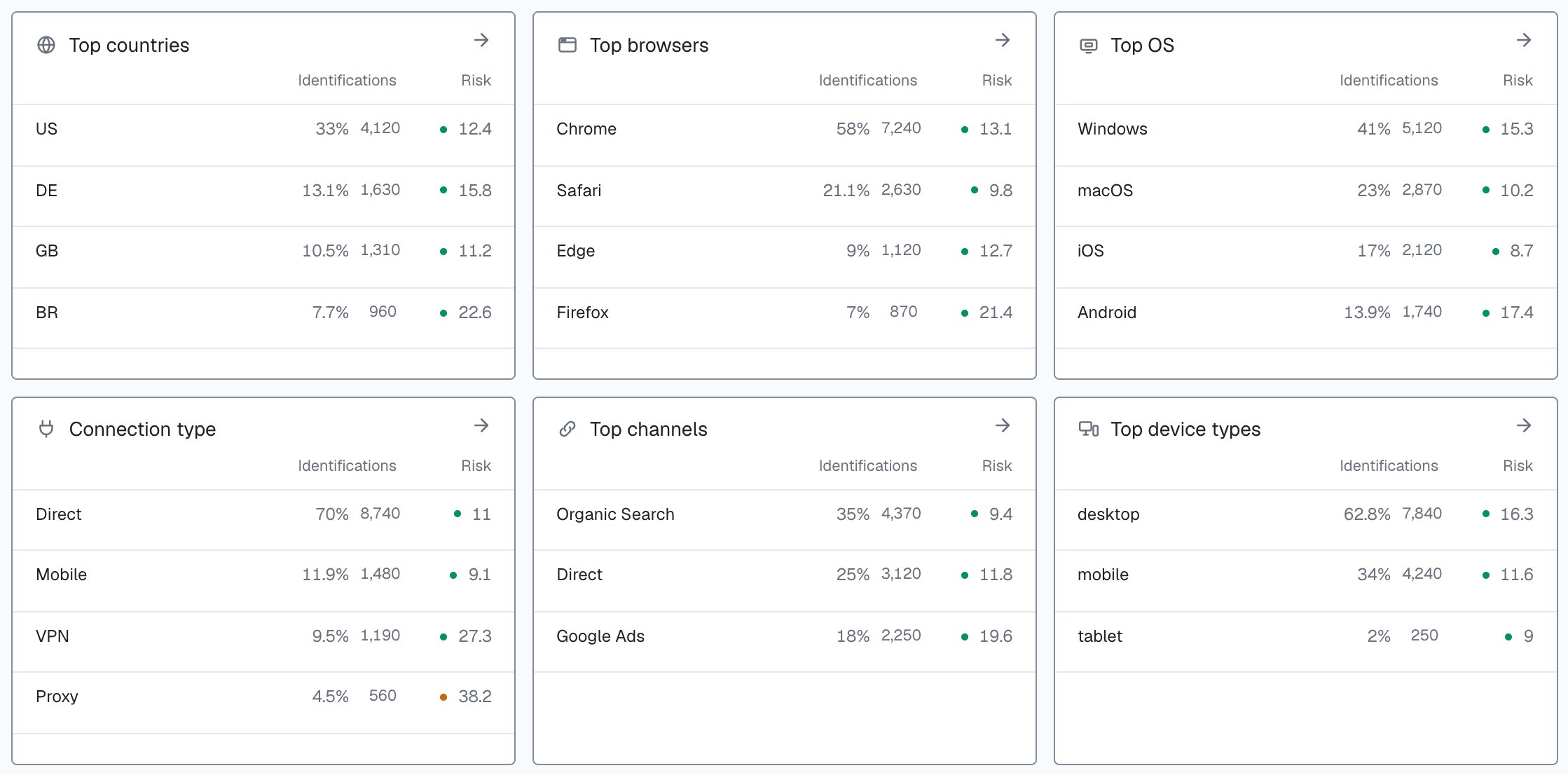
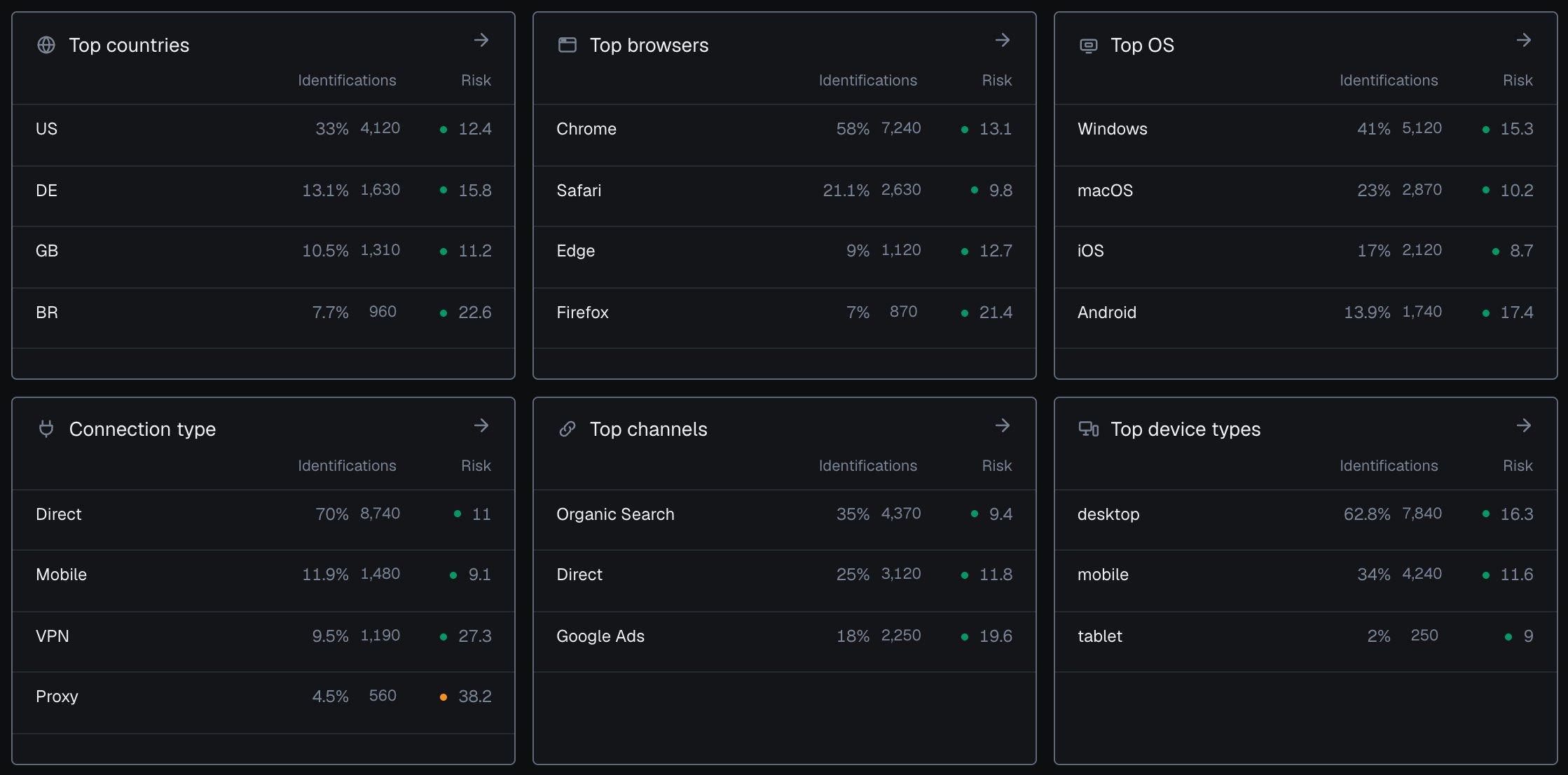
Rank each source by the share of its identifications in the Suspicious and Dangerous bands, so you measure cost per real user instead of cost per click. On Overview, Top channels lists each channel with its identifications and average risk; in Analytics, the Channel, Source and Campaign filters narrow the Identifications tab to one partner’s traffic. Measure Traffic Quality walks through the source breakdown and the export; this page covers the payout decision built on top of it.
Top channels, countries, browsers, OS, connection types and device types in the analytics dashboard, each with its average risk.
3
Identify the new account at conversion
When the lead signs up, identify the new account when the first signed-in page opens, such as the welcome screen or the first checkout page: call forceCheckAuthenticatedUser with its hashed id and post that request ID with the conversion. It runs an identification every time, keeps the current Session ID and restarts the five-minute window, so the conversion always gets its own request ID. onInitialized fires when the check starts, before the snippet has sent the identification, so do not navigate away inside it: store the request ID and let the form submit normally. The lead is now a user in ShieldLabs, with its own risk, its linked devices and IPs, and High-Risk Events. From then on, pass a hashed User HID with checkAuthenticatedUser on every signed-in page. Users, account-level risk and all four High-Risk Events are built on it. Within one visit (while a page of your site stays open in the browser, across route changes in a single-page app and across open tabs), checkAnonymous and checkAuthenticatedUser run at most one identification every five minutes for the same user. A call inside that window posts nothing, counts nothing, and its onInitialized handler receives { status: "not_initialized" }. On a multi-page site, a full page load in the only open tab can start a new visit with its own identification. That window is why the conversion itself uses forceCheckAuthenticatedUser.
welcome.html
<script type="module"> const mod = await import( 'https://cdn.shieldlabs.ai/snippet.js?publicKey=YOUR_PUBLIC_KEY' ); // A fresh identification for the conversion, started when the page opens // so it is sent while the user reads it. onInitialized fires when the check // starts, before the snippet sends it, so it only stores the request ID and // the form submits normally. With no request ID, the conversion is held for // review. The new account's hashed id, rendered by your server after signup. // Never a raw email or user id. mod.forceCheckAuthenticatedUser('8a9f-hashed-account-id', { onInitialized: (result) => { if (result.status === 'initialized') { document.getElementById('shieldlabs-request-id').value = result.requestID; } }, });</script><form id="conversion-form" method="POST" action="/api/conversion"> <input type="hidden" id="shieldlabs-request-id" name="shieldlabsRequestId" /> <input type="hidden" name="eventType" value="signup" /> <button type="submit">Get started</button></form>
4
Tie a conversion to its account and source
When the conversion posts, read two identifications: the conversion’s own, for the account, the device and the Risk Score, and the landing’s, for the source. Both arrive on the webhook; cache them by request_id and read them back with the shared waitForScore helper from the Use Case Tutorials, which falls back to a History API read by request_id. The webhook data carries risk_score, the named signals array, device_id, public_ip, local_ip and traffic_source. A History row carries the same identification with flat fields (score, score_details, ip, country, traffic_channel, utm_source), and the helper maps them to the webhook names, so the handler reads one shape. Your payout logic then withholds or routes to review instead of paying automatically.
api/conversion.js
import { app, waitForScore, band, NIL_DEVICE } from '../shieldlabs-helpers.js';import { isRepeatDevice } from '../lib/dedup.js';app.post('/api/conversion', async (req, res) => { const { eventType, shieldlabsRequestId } = req.body; // request ID of the conversion const accountHid = req.user.hashedId; // the new account's hashed id const affiliateId = req.cookies.affiliate_id; // your own attribution cookie const landingRequestId = req.cookies.shieldlabs_rid; // stashed on the landing page // The conversion's identification (account, device, Risk Score) and the // landing's (source). Either can be null: a missing one is unverified. const risk = await waitForScore(shieldlabsRequestId, 2000); const landing = landingRequestId ? await waitForScore(landingRequestId, 500) : null; const verified = Boolean( risk && risk.user_hid === accountHid && risk.risk_score <= 100 && risk.device_id !== NIL_DEVICE ); // Record every conversion with its quality context, paid or not. const conversion = await db.conversions.create({ affiliateId, eventType, accountHid, requestId: risk?.request_id ?? null, riskScore: verified ? risk.risk_score : null, band: verified ? band(risk.risk_score) : null, signals: risk?.signals ?? [], // null on the History fallback deviceId: verified ? risk.device_id : null, channel: landing?.traffic_source?.channel ?? null, utmSource: landing?.traffic_source?.utm_source ?? null, }); if (!verified) { await holdForReview(conversion.id, 'unverified'); // nothing to verify: hold } else if (await isRepeatDevice(affiliateId, risk.device_id, risk.request_id)) { await holdForReview(conversion.id, 'repeat_device'); // one device, many leads } else if (band(risk.risk_score) === 'Dangerous') { await holdForReview(conversion.id, 'dangerous_identification'); // Dangerous: withhold } else if (band(risk.risk_score) === 'Suspicious') { await approveWithClawbackWindow(conversion.id); // Suspicious: delayed } else { await approvePayout(conversion.id); // Trusted: pay } return res.json({ ok: true });});
Store the Risk Score and its signals on every conversion, even the ones you pay. A single Suspicious identification is noise, but a partner whose new accounts are 40% Suspicious or Dangerous is a reweighting decision, and you cannot rank sources you did not record. The webhook’s detection_flags also gives boolean shortcuts (suspicious_paid_click, anti_detect_browser, browser_automation) for fast routing without re-deriving from signals.
5
Dedup one device arriving under rotated IPs
The hardest abuse to see is a single device that clears cookies and rotates its public IP between events, so each lead looks like a new user from a new location. Cookie- and IP-based dedup both fail. The durable device_id holds: the same browser produces the same Device ID after a cookie clear, an incognito window or an IP change. Dedup conversions on device_id inside your attribution window, not on IP or cookie. The conversion handler above calls this check:
lib/dedup.js
// Has this exact device already converted for this affiliate inside the window?// The first conversion claims the key; a later one is a repeat device.export async function isRepeatDevice(affiliateId, deviceId, requestId) { const key = `affiliate:${affiliateId}:device:${deviceId}`; const firstSeen = await store.setIfAbsent(key, requestId, { ttlSeconds: 86400 }); if (!firstSeen) { // Same device, same affiliate, inside the window: a repeat device, not a // new lead. Mark it so payout does not double-count. await db.conversions.markRepeatDevice(requestId, deviceId); } return !firstSeen;}
For one network behind rotated IPs, compare the two addresses on the webhook: two conversions with different public_ip values but the same local_ip.ip are a strong sign that one person is rotating exit IPs from one network. detection_flags.ip_mismatch marks two different addresses and is informational, so compare the countries rather than branching on the flag alone. A person who uses several separate browsers shows up as several devices, so pair device dedup with the partner-level ranking to surface coordinated traffic.
6
Rank affiliates from the recorded conversions
With the Risk Score, the account and the Device ID stored on every conversion, a daily job ranks each affiliate by the users it actually delivered. This feeds your manual review queue and payout terms; you choose the action for each partner.
A partner at the top of that list, with a high risky share, many accounts per device or accounts with a Multi-accounting event, is the one to move from auto-pay to manual review, renegotiate or hold.
Cross-check in the analytics dashboard before you act. If a utm_source ranks badly in your job, filter Analytics by that Source to see its traffic, then search Analytics for each User HID your job recorded for the partner: each account opens with its band for the period and any Multi-accountingHigh-Risk Event. The source sits on the landing identification and the account on the conversion’s, so your conversion record is what joins them. Two independent views landing on the same partner is a far stronger basis for a payout change than one number.
7
Read a device's full history when you need it
For a borderline source, reconstruct what a single device has been doing across your whole site. Read the History API by device_id.
The response is { "data": [ ... ], "total": N }, newest first in snake_case. Distinct user_hid values on one Device ID can mean one device behind many accounts (leave out "anonymous", which is not an account). Many countries on one Device ID can mean a single person masking location: History rows carry the public IP and its country, and the Local IP country is on the webhook, so compare it with the local_ip.country you stored before you read it as real spread. For identified accounts, the Multi-accountingHigh-Risk Event detects the first shape directly: several accounts run by one person, linked through the devices and network they share. High-Risk Events are available in the analytics dashboard, the API and webhooks.
History API reads never count against your included identifications, and neither do webhook deliveries or the analytics dashboard. For high-volume affiliate flows, lean on the webhook stream.
Click through one of your affiliate links and complete a test signup. Then repeat with a new test account after clearing cookies, again in an incognito window, and once in a second browser on the same machine. The cookie_id and visitor_id change each time, but the device_id on the webhook stays the same across the incognito and cleared-cookie runs, so the dedup above counts those conversions as one device. The second browser returns its own device_id, and so does a separate machine: that is the line your payout logic relies on.Then search Analytics in the analytics dashboard for that Device ID and open it: Linked accounts lists every test account that converted from it, each with the band of its identifications on that device.