Most of a ShieldLabs integration is glue code: load the snippet, verify a webhook, turn a score into a decision. The prompts below are written so you can paste one into your AI assistant, fill in the placeholders, and get working code back. Each one already carries the product facts the model needs, so it does not guess.
Two ways to give your AI tool the full context.
  • Every page in these docs has a menu in the top-right to Copy page, View as Markdown, or open it directly in ChatGPT or Claude with the page preloaded.
  • The entire documentation set is published as a single file at /llms-full.txt (with a short index at /llms.txt). Paste either URL into your assistant to load all of ShieldLabs as background before you ask.

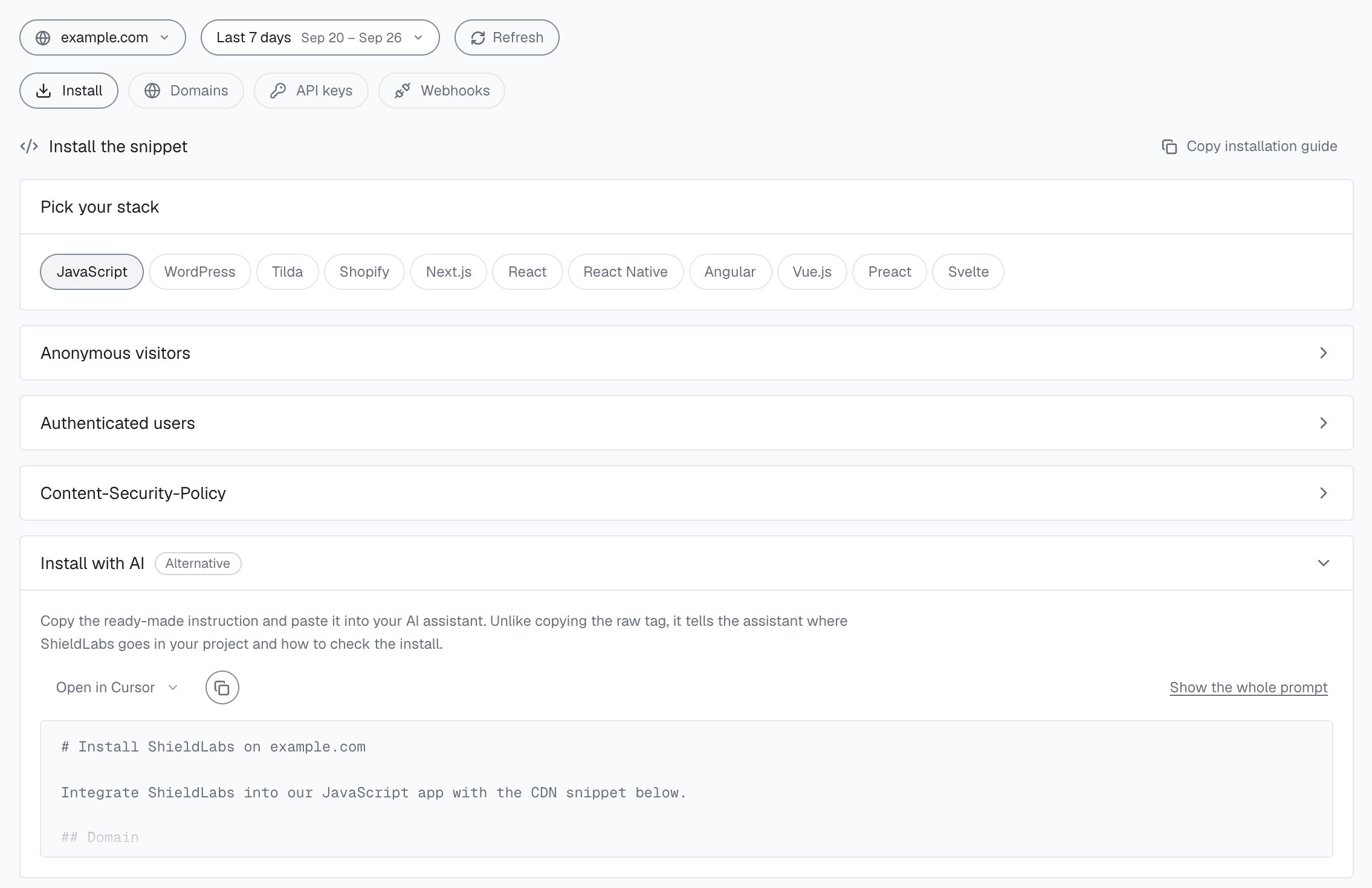
Install the snippet

Replace the placeholders, then paste into ChatGPT, Claude, or Cursor.
You are helping me integrate ShieldLabs visitor identification into my web app.

Stack: <your framework, e.g. Next.js App Router, React, Vue, or plain HTML>.
Public key: <YOUR_PUBLIC_KEY>.

How ShieldLabs loads:
- It is a browser ES module loaded from a CDN. It is NOT an npm package and not a native SDK.
- Load and run it like this:
    const mod = await import('https://cdn.shieldlabs.ai/snippet.js?publicKey=YOUR_PUBLIC_KEY');
    mod.checkAnonymous();
- It runs in the browser, posts signals to ShieldLabs automatically, requests no
  permissions, and must not block page load (use a dynamic import, run it async).
- For a signed-in user, call mod.checkAuthenticatedUser('<hashed-account-id>') instead,
  passing a hash of my user id, never the raw id.

Write the integration for my stack, show exactly where the code goes, and load it on
the pages I want to identify visitors on.

Verify a webhook

Write a <Node + Express, Go, or Python + Flask> webhook handler for ShieldLabs.

Delivery format: ShieldLabs POSTs JSON shaped like
  {
    "Data": {
      ...identification fields...,
      "Score": <0-100>,
      "Details": [ { "Value": <points>, "Description": "<signal>" } ],
      "Phase": "initial"
    },
    "Assing": "<hmac>"
  }

Verification:
- "Assing" is an HMAC-SHA256 of the raw "Data" JSON, keyed with my Secret Key <YOUR_SECRET>.
- Compute the HMAC over the exact received bytes (do not re-serialize) and compare in
  constant time. Reject the request if it does not match.

Reliability:
- Delivery is at-most-once with no retries and a ~1 second timeout.
- Make the handler idempotent on Data.RequestID and return 200 quickly.

Give me the full handler with signature verification and an idempotency guard.

Turn the Risk Score into a decision

I receive a ShieldLabs Risk Score per visit and want to turn it into an action.

Facts:
- Score is 0-100. Bands: Clean 0-9, Low 10-29, Medium 30-59, High 60-100.
- Details is an array of { Value, Description }: the signals that built the score and the
  points each one added.
- Branch on the Score band and on the Details Value, NOT on exact Description text. The
  Description strings are human-readable and not a stable API contract.
- ShieldLabs does not block anything. My code owns the decision: allow, challenge (step-up
  or 2FA), send to manual review, or block.
- A legitimate user can score high (corporate VPN, privacy browser), so weigh the score
  against how sensitive the action is.

Write a function decide(score, details, actionSensitivity) that returns one of
allow | challenge | review | block, with sensible thresholds I can tune per action.

Read a visitor’s history

Write a <language> function that reads a visitor's history from the ShieldLabs Server API.

Endpoint base: https://api.shieldlabs.ai/<YOUR_DOMAIN>:<YOUR_SECRET>/
- The History endpoint returns an array of past snapshots, newest first, each with the
  identifiers, Country, and Score for that visit.
- Auth is the {domain}:{secret} segment in the path. Keep the secret server-side only.
- Billing: a History read bills one request per returned row, so cap how far back I read.

Give me the function plus a short example that fetches the last few snapshots for one
VisitorID and prints how its Score changed over time.

Keep the model honest

When you paste generated code back, sanity-check it against the real product:

Snippet

The real exports, framework examples, and what the browser collects.

Webhooks

The { Data, Assing } envelope and HMAC verification in Node, Go, and Python.

Risk Scoring

The 0-100 score, its bands, and the Details breakdown to branch on.

Server API

History, profile, and callback endpoints with full request and response shapes.
If a model invents an endpoint, an npm package, or a Description value to switch on, it is guessing. Re-prompt it with the page above (Copy page, then paste) and it will correct.